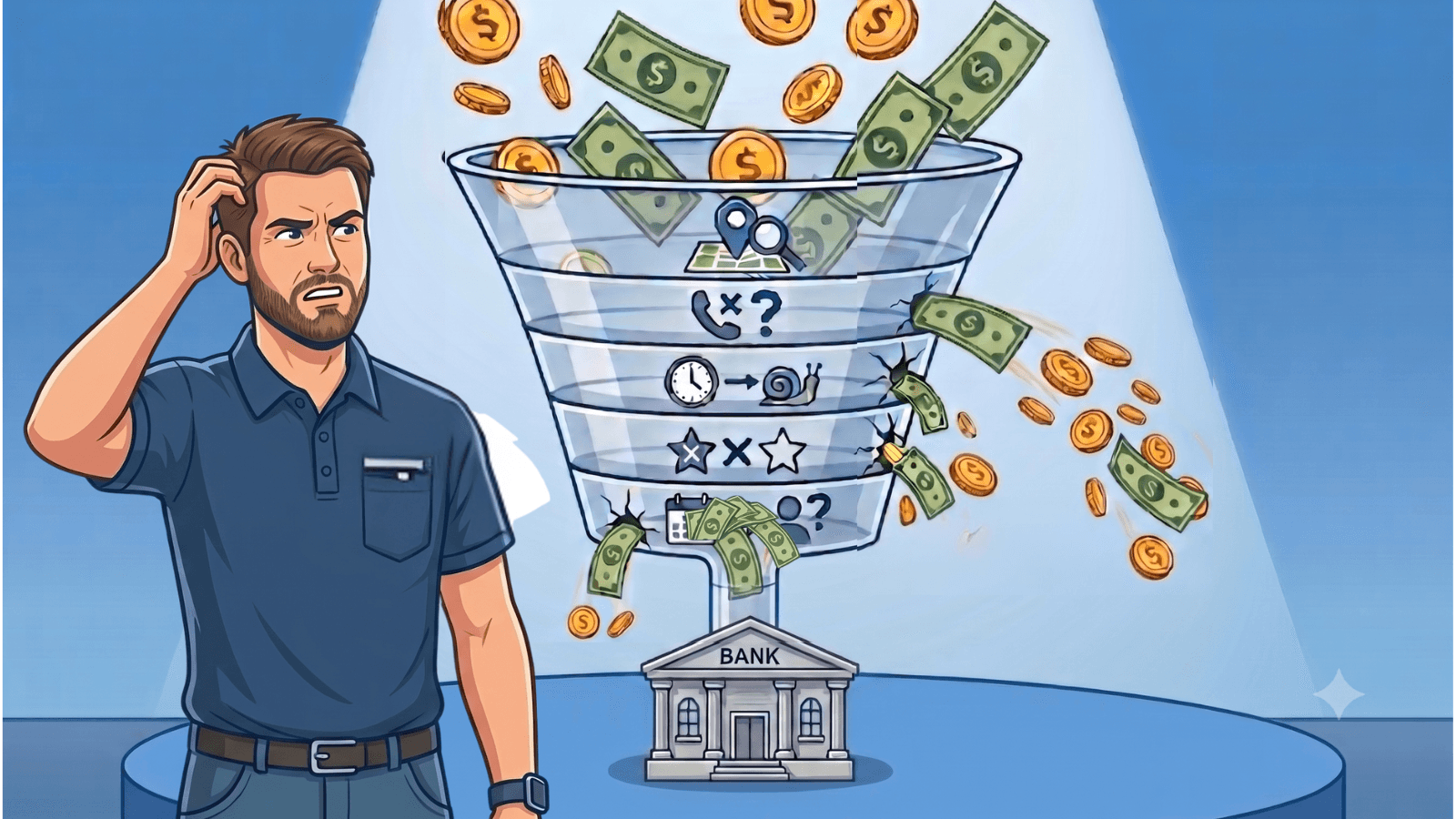
A revenue leak is the job that should've booked, but didn't.
Chad Drew, Founder of Looper Systems
Published May 19, 2026
Not because the business is bad.
Not because the market died.
Usually it's something dumb and normal.
The phone rang during lunch. Nobody grabbed it.
A form came in at 8:14 p.m. and didn't get answered until the next afternoon.
A quote went out, then sat there like a wet sock.
A good customer left happy, but nobody asked for the review.
That's the stuff that bleeds money.
The annoying part is it rarely feels like a leak while it's happening. It feels like a busy day. It feels like, "We need more leads." It feels like the ads are slow or Google is being weird.
Sometimes you do need more leads.
But a lot of local service businesses are already getting chances. They just aren't catching enough of them.
Pouring more ad money into that setup is brutal. More calls missed. More forms half-handled. More people comparing you to three other companies while your team is still trying to figure out who owns the inbox.
Fix the holes closest to cash first.
Start with the leak closest to booked work
Looper helps local service businesses find the calls, follow-ups, reviews, and old contacts that are already costing them money.
See how the Revenue Leak Assessment works.
So what counts as a revenue leak?
For a local service business, a revenue leak is any spot where a real buyer tries to contact you, trust you, book you, or come back again, and the ball gets dropped.
It can be big.
It's usually small.
Stuff like:
Missed calls during the day
After-hours calls that go nowhere useful
Website forms that sit too long
Quotes with no follow-up
Old customers nobody's touched in months
Past leads sitting in a CRM
Happy customers who never got the review link
Bad or messy business info across Google, directories, and listings
Weak visibility in Google, Maps, ChatGPT, Perplexity, Gemini, or other answer tools
None of that sounds sexy.
Good. That's why it gets missed.
Everybody wants the new campaign, the new funnel, the new magic button. Meanwhile you missed seven calls last week and nobody knows if those people booked with someone else.
That's not a traffic problem.
It's a catch problem.
Missed calls are closer to money than most leads
A call isn't the same as a random website visit.
If someone calls a plumber, roofer, dentist, med spa, lawyer, auto shop, HVAC company, or any other local service business, they're probably not doing a book report.
They need help.
And probably fast.
But if nobody answers, they're not sitting there thinking, "Wow, what a strong brand experience."
They hang up and call the next name.
That missed call could've been an appointment, a job, a case, an estimate, a repair, or a repeat customer. But inside the business, it often gets treated like background noise.
"Yeah, we were slammed. We'll call them back."
Cool. Did they answer?
Did they already book someone else?
Did anyone log it?
Did it come from Google, paid search, the website, a referral, or a van wrap?
Most owners don't know. Not because they don't care. Because the system was built around hope.
At minimum, know these numbers:
Calls in
Calls missed
Calls after hours
Time to call back
Source of the call
Whether the call turned into booked work
Start there before arguing about ad spend.
If you don't know your missed-call rate, you're guessing at one of the closest leaks to revenue.
Slow follow-up makes warm buyers cold
Speed matters because timing matters.
That's it.
When someone fills out a form or leaves a voicemail, they're still in motion. They're comparing. They're asking their spouse. They're checking reviews. They're maybe filling out two more forms because nobody wants to wait around.
InsideSales' 2021 lead response research looked at more than 55 million sales activities across 5.7 million inbound leads. The short version: response time matters. A lot. Especially in the first few minutes.
I didn't put that in to sound fancy.
It just confirms what any owner already knows from being a customer. Fast feels safer. Slow feels like work.
You don't need a giant sales floor to fix this.
You need a basic follow-up lane that doesn't depend on someone remembering between handling three other fires.
Example:
Form comes in, someone gets pinged right away
Missed call creates a callback task
Texts land in one watched place
After-hours leads get a clean next step
Quotes get followed up on a set schedule
One human owns the outcome
That last part is where the leak usually lives.
If everyone owns it, nobody owns it.
Put a name on it.
Old contacts aren't dead. They're just ignored.
Most service businesses have money sitting in places they stopped looking.
Old quotes.
Past customers.
No-show leads.
Missed calls.
Text threads.
Referral partners.
People who almost booked, then disappeared because life got busy or the timing was off.
A lot of businesses will spend $3,000 trying to get strangers to care while 800 old contacts sit untouched in the system.
Painful.
And normal.
A dentist has overdue patients. A med spa has people due for another visit. A roofer has old storm estimates. A law firm has referral partners who haven't heard a real update in months. An auto shop has customers due for service.
This doesn't need to turn into spam goblin marketing.
It can be plain:
"You're due for service."
"We have time this week."
"Do you still need help with this?"
"Want us to take another look?"
"We changed how we handle this and can move faster now."
We've seen this in the boring admin pile too.
Old invoices. Half-finished quote threads. Past customers who would've responded if the business had sent one clean note.
Nobody thinks of that as marketing.
But sometimes the money isn't hiding in a new ad campaign. It's sitting in a list the business already has.
The first follow-up doesn't need to be clever. It just needs to give the person a clean next step.
The point isn't to squeeze people.
It's to stop pretending every new booking has to come from a brand new person.
Sometimes the cheapest lead is already in your phone.
Reviews leak trust before the lead ever calls
Reviews are one of those things everybody agrees matter, then nobody owns.
The job gets done. The customer is happy. The team moves on. Then six months later someone asks why the Google profile looks dusty.
Missing reviews hurt in two ways.
First, people trust the business less. If two companies look close enough, the one with better and newer reviews usually feels like the safer bet.
Second, visibility takes a hit. Google, Maps, directories, and AI answer tools all look for public signs that a business is real, active, and trusted.
BrightLocal's 2026 Local Consumer Review Survey found that 97% of consumers read reviews for local businesses, and 85% are more likely to use a business after reading positive reviews.
That's not a cute little signal.
That's buying behavior.
Most review problems aren't service problems. They're process problems.
Nobody asks.
Or the wrong person asks.
Or they ask three weeks later.
Or the link is buried.
Or the message sounds like it was written by a bank compliance team.
A review system only needs to answer a few plain questions:
Who asks?
When do they ask?
What link do they send?
What do they say?
Who replies to reviews?
Are fresh reviews shown on the site and Google Business Profile?
Good service helps.
A simple ask gets the review.
Both matter.
AI search is real, but don't get weird about it
Google and Maps are still the main game for local.
Don't let some LinkedIn thread scare you into rebuilding your whole business around AI search tomorrow morning.
A 2025 Youtech consumer report summarized by PPC Land found that 78.7% of respondents still used traditional search engines first for local business searches. Only 2.0% primarily favored AI assistants.
So no, AI assistants aren't replacing Google for local service businesses right now.
But they aren't fake either.
The same report found that 27.3% of respondents had used AI assistants to find local businesses within the past week.
That's enough to pay attention.
People are asking ChatGPT, Perplexity, Gemini, Google's AI features, and other tools who to call. Stuff like:
"Best emergency plumber near me."
"Personal injury lawyer in Burbank."
"Med spa with good reviews for Botox."
"Roofer near me that handles insurance claims."
Those tools need public signals to work with.
Same as Google, just packaged in a newer way.
The signals aren't mysterious:
Clear service pages
Consistent name, address, and phone number
Complete Google Business Profile
Recent reviews
Local mentions
Directory listings
Useful website content
Schema markup
Proof like awards, credentials, locations, years in business, and real photos
AI visibility sits on top of local SEO.
If the local SEO is thin, messy, or stale, the AI layer has less to trust.
Clean up the basics before chasing the shiny thing.
The quickest way to find the leak
Don't start with a 47-tab spreadsheet.
Start with the stuff closest to booked work.
Pull call logs first. Look at missed calls, voicemails, and after-hours calls.
Not guesses. Actual logs.
How many came in? How many got missed? How many got called back fast enough to matter?
Then look at response time.
Pick a normal week and check forms, calls, texts, and quotes. How long did people wait?
Minutes and hours. Not vibes.
Then look at old money.
When did you last contact past customers, old quotes, or old leads?
If the answer is "uhh," there's probably a leak.
Then reviews.
Do happy customers get asked every time, or only when someone remembers?
Random asks create random review growth.
Then check where people ask who to call.
Search Google and Maps. Then test ChatGPT, Perplexity, Gemini, and whatever else your buyers might use.
Do you show up?
Do you look trustworthy when you do?
Do the facts match across profiles?
You don't need to fix everything at once.
Find the leak closest to a booked job and fix that first.
For one business it's missed calls. For another it's quote follow-up. For another it's reviews. For another it's an old customer list that's been ignored for two years.
Different leak. Same problem.
Money was close, then it slipped.
What should you fix first?
If this were my local service business, I wouldn't start with more blog posts or another ad campaign.
I'd start here:
Answer more calls.
Call back missed calls faster.
Follow up on every form and quote.
Reactivate past customers and old leads.
Ask happy customers for reviews.
Clean up Google Business Profile and local listings.
Build content that helps Google and AI tools understand who you serve, where you work, and why people trust you.
That order isn't perfect for every business.
But it's a good gut check.
Because more traffic only helps if you can catch it.
If the bucket has holes, fix the bucket before buying more water.
Revenue leak FAQ
What is a revenue leak?
A revenue leak is missed money that should've turned into booked work. For a local service business, it usually comes from missed calls, slow follow-up, old contacts, weak reviews, or poor visibility in Google and AI search.
How do local businesses lose leads?
Local businesses lose leads when people can't reach them, don't hear back fast enough, don't see enough trust signals, or find a competitor who's easier to contact and book.
Why do missed calls cost revenue?
Missed calls cost revenue because callers usually need help soon. If nobody answers, many people call the next business and book there instead.
Why do reviews matter for local businesses?
Reviews help customers decide who feels safe to hire. They also give Google, Maps, directories, and AI tools public proof that the business is active and trusted.
Is AI search replacing Google for local businesses?
No. Google and Maps are still the priority. But AI tools are becoming another place where customers ask for recommendations, so local businesses need clean, consistent, trustworthy online signals.
Where Looper fits
A Revenue Leak Assessment shouldn't feel like a giant marketing overhaul.
It should answer a plain question:
Where is booked work slipping away right now?
Usually the first clues are in missed calls, slow follow-up, old contacts, reviews, and local search visibility.
Looper helps local service businesses find those leaks and fix the ones closest to booked work.
Start there.
About the author
Chad Drew is the founder of Looper Systems. Based in Manhattan Beach, Looper helps local service businesses stop losing revenue from missed calls, slow follow-up, weak reviews, and poor visibility in Google and AI answers.
Want to know where your biggest leak is?
Start with a Revenue Leak Assessment and we’ll look at the five places local service businesses usually lose booked work: missed calls, slow follow-up, stale contacts, reviews, and search visibility.