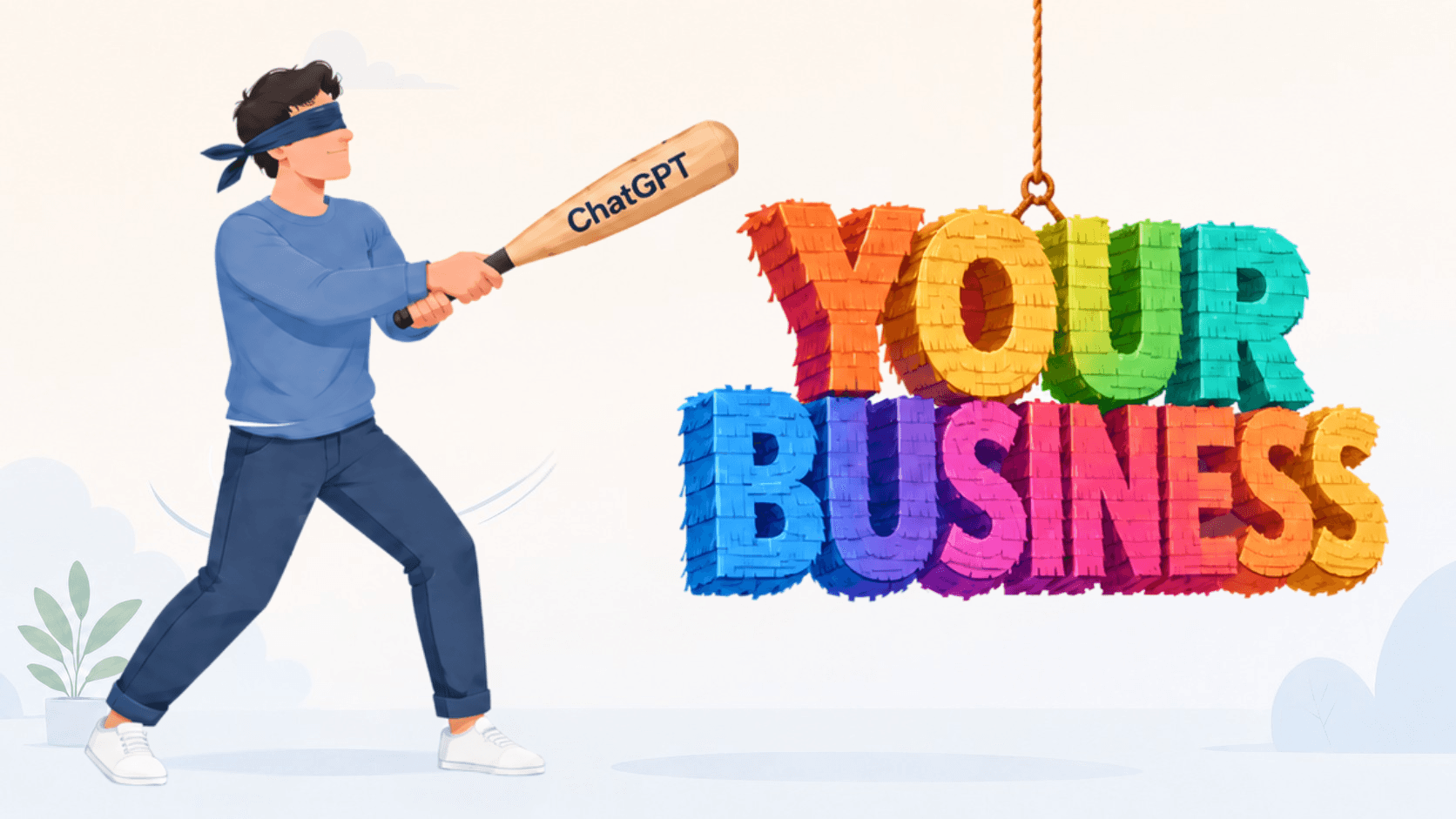
Your website can be live, indexed by Google, and still be almost invisible to AI tools.
That sounds weird until you think about how people search now.
They're not only typing "roofer near me" or "estate planning attorney Manhattan Beach" into Google.
They're asking things like:
Who should I call for a roof leak in the South Bay?
What should I ask before hiring a probate attorney?
Which local business can help with missed calls and follow-up?
Who has experience with commercial laser cleaning?
Then ChatGPT, Perplexity, Google AI Overviews, Gemini, and other answer engines try to build an answer from what they can understand and trust.
If your website is thin, vague, disconnected from the rest of your online footprint, or missing basic structure, you may not show up at all.
Not because your business is bad.
Because the machine can't confidently explain who you are.
AEO is not magic SEO with a new name
AEO means Answer Engine Optimization.
Plain English: it's the work of making your business easier for AI tools and search engines to understand, verify, and cite.
Traditional SEO asks, "Can this page rank?"
AEO asks a different question:
"Can an answer engine figure out that this business is a credible answer to a real buyer question?"
That requires more than keywords.
It needs clear services, clean entity signals, useful answers, consistent profiles, trusted third-party mentions, reviews, schema, and proof that matches what the business actually does.
Most local businesses do not have that.
They have a homepage, a few service blurbs, a Google Business Profile, some reviews, and a bunch of half-finished profiles floating around the internet.
That may have been enough when search was mostly blue links.
It's not enough when the buyer asks an AI tool to summarize the market for them.
The problem is not that AI hates your website
AI tools don't hate your website.
They just don't have enough clean signal to work with.
A business can become hard to recommend for boring reasons:
The services are too vague
The location or service area is unclear
The business name is inconsistent across profiles
The founder or team isn't connected to the brand anywhere
The site has no useful answers to common buyer questions
The reviews mention one thing while the website sells another
The site has weak or missing schema
Third-party profiles are incomplete or outdated
There is no clear proof of authority outside the company's own website
None of these feel urgent day to day.
But together, they create a visibility problem.
A human might still understand what you do after clicking around for five minutes.
An answer engine may not give you that chance.
What answer engines need to see
Think of AI visibility as a trust file.
The more complete the file, the easier it is for a tool to include you in an answer.
A strong trust file usually includes five things.
1. Clear entity signals
The internet needs to agree on who you are.
That means your business name, founder, location, service area, category, phone number, website, and former names should not be scattered or contradictory.
If your company rebranded, changed domains, moved locations, or used multiple names over time, clean that up.
AI tools are good at connecting dots, but they are also good at getting confused when the dots are messy.
2. Direct answers to buyer questions
Most websites talk about themselves.
Answer engines need pages that answer buyer questions clearly.
For example:
What does this service cost?
Who is this for?
What problems does it solve?
What happens during the first call?
What should a customer check before choosing a provider?
What makes this business different from the other options?
You don't need to publish a giant blog farm.
You need enough useful pages that explain the business in the same way a good salesperson would.
3. Structured data
Schema doesn't magically make a bad website rank.
But it does help search engines understand what's on the page.
For local businesses, that usually means clean Organization, LocalBusiness or ProfessionalService, Service, Article, FAQPage, and Person schema where appropriate.
The key is that the schema must match the visible page.
Don't stuff invisible claims into JSON-LD and pretend that is authority.
That's not strategy. That's spam in a nicer outfit.
4. Third-party confirmation
Your website saying you're credible is one signal.
Other trusted places saying the same thing is stronger.
That can include:
Google Business Profile
LinkedIn profiles
Local chamber pages
Industry directories
Professional association profiles
Podcast appearances
Guest articles
Real reviews
Relevant local mentions
This is where a lot of businesses get tempted by fake accounts, fake reviews, and weird authority hacks.
Do not do that.
Clean authority is slower, but it doesn't blow up later.
5. Consistency over time
AI visibility is not one page.
It is the pattern across your website, profiles, reviews, content, and mentions.
If your homepage says one thing, your Google profile says another, your LinkedIn has an old brand name, and your service pages are generic, the system has to guess.
Guessing is bad.
Clear beats clever.
Consistent beats noisy.
Where tools like Architect AEO fit
AEO tools can be useful because they turn an invisible problem into a scorecard.
We built Architect AEO to evaluate a website's readiness for Answer Engine Optimization using a BRAIN Framework, including areas like indexability, brand representation, and authority.
The reason we built it is simple: most businesses can't fix what they can't see.
A scan can show where the site is weak.
But the tool isn't the strategy.
The score is the smoke alarm.
The work is fixing the wiring.
If Architect AEO says your site has weak brand representation, the fix isn't to chase the score blindly. The fix is to ask why the brand is unclear.
Is the About page thin?
Are founder profiles disconnected?
Are service pages vague?
Are third-party profiles incomplete?
Is the business using an old name in some places and a new name in others?
That's the useful part.
The tool points at the problem. A human still has to decide what matters and what is just noise.The basic AEO setup every local business should have
Before chasing advanced tactics, get the boring foundation right.
Use this checklist:
Your homepage clearly says who you help, what you do, and where you work.
Your service pages answer the real questions buyers ask before calling.
Your About page connects the business, founder, location, and proof.
Your Google Business Profile matches the website.
Your LinkedIn and major profiles use the same business story.
Your reviews support the services you want to be known for.
Your schema matches the visible page copy.
Your best pages include plain-English FAQs.
Your content uses real examples, not generic marketing fog.
Your third-party mentions reinforce the same identity.
None of this is flashy.
That's the point.
The businesses that become easy to recommend are usually easy to understand first.
The warning sign
Here's the simplest test:
Open ChatGPT or Perplexity and ask a buyer-style question that should include your business.
Not your exact brand name.
A real question.
Something like:
"Who helps local service businesses in the South Bay with missed calls and follow-up automation?"
Or:
"What should I ask before hiring an estate planning attorney in Manhattan Beach?"
Then look at what comes back.
If your business is missing, the answer might not be "we need more blog posts."
It might be:
The business is not clearly connected to the category
The site does not answer the right questions
The entity signals are weak
The authority signals are thin
The proof is trapped in places AI tools cannot easily use
That is the real work.
What Looper looks for first
Looper doesn't start with tricks.
We start by asking whether your business is understandable to the systems buyers now use.
That means looking at:
What AI tools say about your category
Whether your business appears in relevant answers
Whether your website explains your services clearly
Whether your entity signals are clean
Whether your schema supports the visible page
Whether your profiles and reviews tell the same story
Whether there are authority gaps worth fixing
Then we rank the fixes.
Because not every visibility problem deserves your time.
Some pages need clearer answers.
Some profiles need cleanup.
Some service categories need better proof.
Some businesses need to stop chasing content and fix the basics.
The point
Your website doesn't need to be everywhere.
It needs to be clear enough, consistent enough, and trusted enough that search engines and AI tools can understand when your business is a good answer.
That's AEO.
Not fake accounts.
Not spam comments.
Not a giant pile of AI-written blog posts.
Just clean, structured, useful signals around the real business.
If your business is invisible in ChatGPT, Perplexity, or Google AI answers, the fix probably starts with your setup.
Not with more noise.
About the author
Chad Drew is the founder of Looper Systems, a Manhattan Beach company that helps local service businesses stop losing revenue from missed calls, slow follow-up, weak reviews, and poor visibility in Google and AI answers.
Want to know if your business is visible to AI tools?
Looper Systems helps local service businesses clean up the signals that search engines and AI tools use to understand who to recommend.
Start with a Visibility Assessment.
We will look at how your business shows up across your website, Google, AI answers, profiles, reviews, and third-party sources, then show you what to fix first.